The Father’s Day Photo Fiasco: How Prince Harry’s Tribute to Archie and Lilibet Sparked a Global Controversy
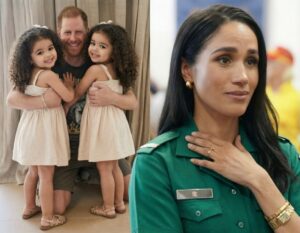
For years, Prince Harry and Meghan Markle have maintained an ironclad grip on their children’s privacy. Since stepping back from senior royal duties in 2020 and relocating to Montecito, California, the Duke and Duchess of Sussex have rarely allowed the public a glimpse of their two children, Prince Archie and Princess Lilibet. This calculated secrecy has always heightened public curiosity.
However, what was meant to be a heartwarming and historic gesture on Father’s Day turned into a public relations disaster. When Prince Harry broke his usual protocol to share a series of intimate photographs featuring his young son and daughter, the internet reacted with a mix of awe and immediate skepticism. Within hours, eagle-eyed royal watchers, photographic experts, and internet sleuths began dismantling the images, leading to a massive controversy that left the Sussexes accused of visual manipulation and a desperate bid for media attention.
The Father’s Day Surprise
The controversy began on Father’s Day morning when a digital tribute was uploaded, showcasing Prince Harry enjoying tender moments with Archie and Lilibet. The images presented a idyllic picture of American royal life: a candid shot of Harry laughing while lifting a toddler high in the air against a backdrop of golden California sunshine, and a black-and-white portrait of him reading a book with his children nestled closely on either side.
For a brief moment, the internet was captivated. It felt like a rare, authentic look behind the gates of their Montecito mansion. Media outlets rushed to publish the images, praising Harry’s dedication to fatherhood and drawing poignant parallels to his own upbringing under the intense lens of the British paparazzi. The narrative seemed perfect—until the internet did what the internet does best: look closer.
Exposed: The Digital Anomalies and Timeline Gaps
The praise quickly evaporated into a cloud of suspicion as social media users began analyzing the high-resolution files. It didn’t take long for seasoned digital editors and royal commentators to point out glaring inconsistencies that suggested the photos were far from the fresh, spontaneous glimpses into current family life they were framed to be.
+-----------------------------------------------------------------------+
|                    The Discrepancies in the Photos                    |
+-----------------------------------------------------------------------+
|  The Allegation                       |  The Photographic Evidence    |
|---------------------------------------|-------------------------------|
|  1. Reused Imagery                    |  * Wardrobe matches a 2022    |
|                                       |    Netflix documentary scene. |
|---------------------------------------|-------------------------------|
|  2. Digital Manipulation              |  * Unnatural blurring and     |
|                                       |    cloned background elements.|
|---------------------------------------|-------------------------------|
|  3. Age Inconsistencies               |  * The children appear much   |
|                                       |    younger than their actual  |
|                                       |    current ages in 2026.      |
+-----------------------------------------------------------------------+
1. The Recycled Netflix Footage
The first major blow to the authenticity of the post came when internet sleuths cross-referenced the clothing worn by Prince Harry and young Archie. Critics quickly noticed that the “new” candid shot perfectly matched the outfits, lighting, and specific scenery from a brief clip used in the couple’s 2022 Netflix docuseries, Harry & Meghan. This realization sparked immediate backlash; the public felt misled by a photo presented as a current celebration of fatherhood that was, in reality, a four-year-old leftover from a corporate media package.
2. The Heavy Hand of Photoshop
Worse still was the analysis of the black-and-white portrait. Digital photography experts pointed out blatant signs of heavy editing and “cloning.” The shadow cast by Princess Lilibet’s shoulder did not align naturally with the direction of the overhead light source. Furthermore, certain areas around Prince Harry’s hairline and the edges of the children’s clothing showed suspicious pixelation and unnatural blurring—classic hallmarks of an amateur digital composite. Speculation exploded that the image had been stitched together from multiple different photos taken at entirely different times.
The Backlash: Why the “Expose” Hurt the Sussex Brand
The swift debunking of the Father’s Day photos triggered a wave of intense criticism. For a couple that has consistently championed digital authenticity, fought against misinformation, and sued media outlets over privacy violations, being caught in a web of photographic manipulation was a severe blow to their credibility.
Critics wasted no time labeling the stunt as a calculated PR maneuver. Coming at a time when the British Royal Family—particularly King Charles III and the Princess of Wales—have dominated headlines with their own personal health battles and public appearances, the timing of Harry’s photo drop felt suspect to many.
“It appears to be a desperate bid to remain relevant on a day highly tied to family sentiment. Passing off old, highly edited images as a current family milestone insults the intelligence of the public.”
— British Media Commentary Extract
Supporters of the Duke and Duchess rushed to their defense, arguing that any public figure has the right to edit their photos or protect their children’s current appearances by using older imagery. However, the counter-argument remained firm: if the goal was privacy, sharing no photos would have been respected. Sharing heavily manipulated, recycled content while implying it was fresh was bound to invite skepticism.
A Familiar Royal Photo Scandal
The Father’s Day controversy also drew immediate and ironic comparisons to past royal photo scandals. The public vividly remembers the global media frenzy surrounding the Princess of Wales’s edited Mother’s Day photo, which resulted in major international news agencies issuing “kill notices” on the image due to digital manipulation.
At that time, commentators sympathetic to the Sussexes had subtly suggested that Meghan and Harry would “never make such a mistake,” boasting about their seamless, professional media operation. The exposure of Harry’s own Father’s Day photo blunder leveled the playing field in the worst way possible. It proved that the pressure to present a flawless, curated reality plagues both sides of the fractured royal family, stripping the Sussexes of their perceived high ground regarding media professionalism.
The Deeper Implications for Archie and Lilibet
Beyond the immediate PR fallout, the incident highlights the ongoing, complex dilemma surrounding Prince Archie and Princess Lilibet. By keeping them completely hidden except for rare, highly managed, and now debunked media drops, Harry and Meghan have inadvertently turned their children into ultimate media commodities.
Every time a photo is released, it is treated not as a simple family update, but as a high-stakes event to be analyzed under a microscope. This environment makes it nearly impossible for the children to have a normal relationship with the public eye as they grow up.
Conclusion: A Lesson in Authenticity
Prince Harry’s Father’s Day controversy serves as a stark reminder of the perils of modern celebrity PR. In an era dominated by advanced technology and hyper-vigilant internet audiences, attempts to manipulate a narrative through curated or recycled imagery are almost always exposed.
For the Duke of York or the Prince of Wales, public scrutiny is an occupational hazard. For Prince Harry, who chose a life away from the royal fishbowl to seek a more “authentic” existence, the Father’s Day fiasco was a harsh lesson. In trying to control the narrative too tightly, he accidentally created a new scandal, proving that in the court of public opinion, a transparent truth is always better than a heavily photoshopped illusion.
